
California Seismic Retrofit Grants: Who Qualifies
California's Earthquake Brace + Bolt grant pays up to $3,000, plus $7,000 for lower-income owners of older wood-frame houses in listed ZIP codes.
Last updated November 2026
Contents5
California pays part of the cost of bolting an older house to its foundation. The Earthquake Brace + Bolt grant pays up to $3,000 for owners of older wood-frame houses in listed ZIP codes, and a household earning $94,480 or less can add up to $7,000 more. CRMP, the California Residential Mitigation Program, runs the grants.
CRMP reports more than $100 million in grants and more than 40,000 completed retrofits since it formed in 2011.
What each program pays
| Program | What it pays |
|---|---|
| Earthquake Brace + Bolt (EBB) | Up to $3,000, plus up to $7,000 more for a household at or below $94,480 |
| Earthquake Soft-Story (ESS) | Up to 75% of the total cost, capped at $13,000 |
| Earthquake Multi-Unit Retrofit (EMR) | Up to 70% of the retrofit cost, capped at $4,260 per unit, plus up to $7,000 in engineering fees |
Scroll for more →
Within EBB, the standard grant and the supplemental grant can be combined. CRMP says the pair may cover up to 100 percent of the retrofit cost for a qualifying lower-income household, as long as funds remain.
EBB is funded by the California Earthquake Authority's Loss Mitigation Fund and by the FEMA Hazard Mitigation Grant Program. ESS is still a pilot program. Check its ZIP list before you plan around it.
Who qualifies
Work through these checks in order. A house has to pass every one that applies to its program.
- Own the house. EBB and ESS are for owners. CRMP now accepts non-owner-occupied houses under EBB, so a landlord can apply for a rental. ESS expects the owner to live there.
- Check the ZIP code. Each program publishes its own list, and a house outside the list cannot be funded. For EBB, more than 1,100 high-hazard ZIP codes qualified as of January 2025.
- Check the ground. The house must sit on level ground or a slight slope.
- Check the frame. The house must be wood-framed.
- Check the age and foundation. EBB covers houses built before 1980 with a raised foundation or crawl space. ESS covers houses built before 2000 with a living space over the garage. EMR covers buildings built before 1991 with 5 to 10 units.
- Check for earlier work. A completed brace-and-bolt retrofit rules out EBB, and a completed soft-story retrofit rules out ESS. Under ESS, a crawl space that still needs work is retrofitted along with the garage.
- For EMR, check the city's order. The owner needs a notice and order to retrofit from a city with a mandatory multi-unit ordinance.
EBB's ZIP codes were ranked on two measures, weighted equally. One is the USGS earthquake hazard map for California. The other is the share of pre-1940 houses in each ZIP code, taken from Census data, because older houses more often need bracing and bolting.
What the work involves
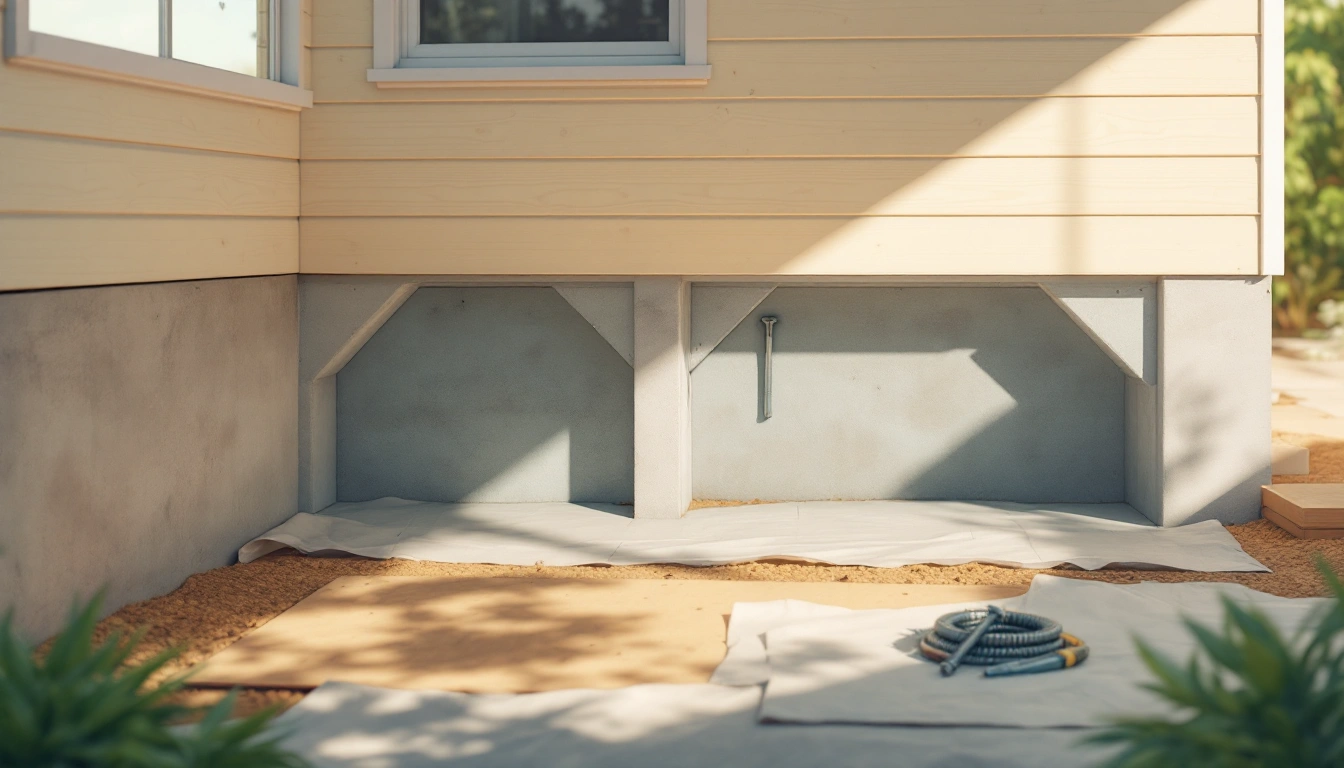
A raised foundation needs three fixes. Bracing applies only where there are cripple walls; bolting and water heater strapping apply to every raised-foundation house.
- Brace the short walls between the house frame and the foundation with plywood or OSB sheathing.
- Bolt the wood frame to the concrete with anchor bolts or foundation plates.
- Strap the water heater to the wall.
The bracing applies when the crawl space has cripple walls. These are the short walls, four feet or less, that carry the house above its foundation. When the frame sits straight on the foundation, the job is bolt-only. Either way, the work must follow the California Existing Building Code, Chapter A3.
A soft-story retrofit goes further. The garage front wall gets a new concrete foundation, then a steel column or a proprietary shear wall where there is too little room for plywood. A collector beam across the garage ceiling ties the floor framing together, and plywood shear walls go on the back and side walls. The work needs a building permit and must follow FEMA P-1100. If the house also has a crawl space, that part is retrofitted too.
The code chapter covers light wood-frame houses only. A post-and-pier house or a hillside house needs an engineered design instead, and CRMP points those owners toward one rather than a standard plan set.
Bolting keeps a house on its foundation, which is a different job from the response when the ground starts moving. Our guide to what to do during an earthquake covers the drop, cover and hold on steps, and what to do in an earthquake works through each room and situation. The house is only half of the plan: our earthquake kit guide covers the water, light and radio that go inside it.
What a retrofit costs
CRMP puts a contracted brace-and-bolt retrofit at $3,000 to $7,000. The spread comes from the size of the house, local labor rates and the amount of material the crawl space needs. An experienced owner-builder can spend less than $3,000, but their own labor is not reimbursable and tools should be rented rather than bought.
Soft-story work costs far more. CRMP estimates $15,000 to $28,000 for a single-family house, and foundation work can push that higher.
That gap is why the grants are partial. Each program sets a ceiling rather than matching the full bill.
One condition catches owners in flood zones. When a FEMA-funded grant reaches $5,000 or more on a house in a Special Flood Hazard Area, the owner must keep flood insurance on the property and record a notarized form with the county before payment. CRMP's program pages list the exact steps.
How to register, step by step
CRMP's how-to-register page lists the steps for Earthquake Brace + Bolt, Earthquake Soft-Story, and Earthquake Multi-Unit Retrofit.
- Check the ZIP list first. A house outside the listed codes cannot be funded, whatever its foundation.
- Answer the qualification questions. The online form asks for the ZIP code, the year the house was built and whether it has a crawl space. A wrong answer can disqualify a house later, after the work is done.
- Register inside the window. Online is the usual route. A paper form must be postmarked by the closing date, and an incomplete form is not accepted.
- Wait for the selection email. Homeowners are picked at random once registration closes. Anyone not picked goes on a waitlist and may be accepted in the following months.
- Do not pull a permit or start work before acceptance. Work begun early forfeits the grant.
- File the income form, if you want the extra money. Every earner in the household must complete the electronic Income Verification Form within 30 days of acceptance. CRMP checks it with the IRS.
- Hire from the directory, or build it yourself. Contractors on the CRMP list are California-licensed and trained by FEMA. EBB allows an experienced owner-builder. ESS does not.
- Claim through the dashboard. The homeowner dashboard holds the approval to proceed and receives the documents.
CRMP's email list is the practical way to hear about the next registration window.
Questions people also ask
Can renters apply for a retrofit grant?
No. The grants go to the owner of the house, not to a tenant. A landlord can apply for a rental, because CRMP now accepts non-owner-occupied houses under Earthquake Brace + Bolt. Earthquake Soft-Story expects the owner to live in the house, and the multi-unit program is for owners of buildings with 5 to 10 units.
Does the grant pay for chimney bracing?
No. CRMP states that neither Earthquake Brace + Bolt nor Earthquake Soft-Story covers work on chimneys. A chimney is a separate job with its own permit and its own cost. The grant covers only the work in each program's rules: for EBB, bracing, bolting and water heater strapping; for ESS, the garage and any crawl-space retrofit.
Can I do the retrofit work myself?
Under Earthquake Brace + Bolt, yes, if you are an experienced owner-builder. Your own labor is not a reimbursable cost, and tools should be rented rather than bought. Earthquake Soft-Story requires a contractor from the CRMP directory, so a homeowner cannot do that work alone.
Do I need an engineer?
Usually not for a house. Earthquake Soft-Story uses FEMA P-1100, a set of pre-engineered plans that many houses can follow without site-specific design. A house outside those plan limits does need a licensed design professional. The multi-unit program always requires one.
What happens if I am not selected?
You go on a waitlist. CRMP picks homeowners at random after registration closes, then accepts more from the waitlist in the following months. Registration does not guarantee a grant, and neither does a place on the list.
When does registration open?
CRMP runs registration in short windows, usually once a year or as funding allows, and its email list announces each one. The multi-unit program is the most recent example, open from August 19 to September 30, 2026. Brace + Bolt and Soft-Story dates change each round.