
3 Purify Water Filter Options: Filter vs Purifier in 2026
As an Amazon Associate, this website earns from qualifying purchases.
The short answer
Choose by the contaminant claim: ordinary microfilters need another method for viruses, while a purifier needs explicit virus evidence.
Last updated October 2026
Contents7
- #1. Survivor Filter PRO: best pump option with a virus-removal claim
- #2. Sawyer Squeeze: best squeeze-filter route
- #3. LifeStraw Personal Filter: best drink-through backup
- Factors to consider for a purify water filter
- What filters and purifiers remove
- Use clean and dirty sides correctly
- Verdict: purify water filter
Our top 3 picks
- 1Best virus-claim pump
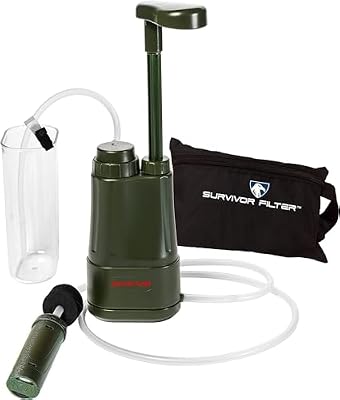 Survivor Filter PRO Pump Filter
- Hand pump with a listed flow of 500 ml per minute
- Three stages, including a 0.01-micron ultra filter
- Maker lists NSF/ANSI-standard testing
- 2Best squeeze-filter route
 Sawyer Squeeze Water Filter
- 0.1-micron absolute filter, about 2 ounces
- Two 32-ounce squeeze pouches included
- Fits 28 mm bottles and works in a gravity setup
- 3Best drink-through backup
 LifeStraw Personal Water Filter
- Drink straight through it; no power or chemicals
- Maker lists removal of bacteria and parasites
- Listed life of about 1,000 gallons
For a purify water filter search, the key choice is filter versus purifier. A small-pore filter can remove bacteria and parasites. Viruses need another step. The CDC recommends disinfection after ordinary portable filtering. Choose gear with clear claims for the germs in your source. A name or clearer taste is not enough.
#1. Survivor Filter PRO: best pump option with a virus-removal claim
Survivor Filter PRO Pump Filter
Our verdict:
Best virus-claim pump
Best for a source where virus removal is part of the gear decision.
View on Amazon- Hand pump with a listed flow of 500 ml per minute
- Three stages, including a 0.01-micron ultra filter
- Maker lists NSF/ANSI-standard testing
Keep in mind: the maker's claim is for tested organisms; check the current instructions and test evidence for your use.
Product details checked September 2026
The maker's product page reports tests for a named virus. It also lists tests for bacteria and parasites. It lists the complete pump at 12.8 ounces and a flow of 500 milliliters per minute. It takes more effort to carry and use than a squeeze filter. Its claimed job also covers more types of germs.
That is a claim for the tested germs. It is not a promise to clean any water. Compare the test evidence for the exact model. A broad testing claim does not prove that the pump removes every kind of pollution.
#2. Sawyer Squeeze: best squeeze-filter route
Our verdict:
Best squeeze-filter route
Best for a portable setup where you will add another germ-treatment step as needed.
View on Amazon- 0.1-micron absolute filter, about 2 ounces
- Two 32-ounce squeeze pouches included
- Fits 28 mm bottles and works in a gravity setup
Keep in mind: ordinary microfiltration does not address viruses; plan disinfection for that risk.
Product details checked September 2026
This is a filter-first approach. Squeezing water into a clean vessel lets you treat a batch and carry it onward. The CDC says bacterial removal needs an absolute pore size of 0.3 micron or smaller, and parasite removal needs 1 micron or smaller. Check the exact product's claims as well as its pore size.
#3. LifeStraw Personal Filter: best drink-through backup
LifeStraw Personal Water Filter
Our verdict:
Best drink-through backup
Best for a simple backup where drinking through a straw suits the job.
View on Amazon- Drink straight through it; no power or chemicals
- Maker lists removal of bacteria and parasites
- Listed life of about 1,000 gallons
Keep in mind: a straw is for direct drinking; choose a pump or squeeze filter for filling batches.
Product details checked September 2026
The listing says it removes bacteria and parasites. Keep a clean carrying-water method alongside it if you need water for meals or other people. A straw can suit direct drinking, but the whole trip or outage needs more than that one task.
Factors to consider for a purify water filter
We used the CDC emergency treatment guide and CDC Yellow Book field-treatment guidance for germ differences. We did not test these by hand. Details come from each listing; the Survivor maker page provides its specific virus-test claim.
Match the method to the source. The Yellow Book sets out needs for water far from people. It also covers water near people or animals.
Where several germ risks exist, it gives options such as heat or UV. A small-pore filter with disinfection is another route. Even clear water needs the right treatment.
What filters and purifiers remove
Check three groups of germs. These are bacteria, viruses and parasites such as Giardia or Cryptosporidium. The CDC explains that ordinary portable filters do not remove viruses. A purifier needs to close that gap. Use gear with a clear virus claim or add a step that kills germs.
The CDC Yellow Book gives the testing thresholds for makers claiming the EPA water-purifier designation:
- At least 99.9999% removal of bacteria.
- At least 99.99% removal of viruses.
- At least 99.9% removal of Cryptosporidium oocysts or Giardia cysts.
The CDC says makers must conduct testing to show those results; the EPA does not independently test the claims. Look for evidence for all three groups. A pore-size label alone does not prove that a product meets this standard.
The same source says 0.01-micron ultrafilters should remove viruses, bacteria and parasites. Ordinary microfilters do not reliably remove viruses. Use the tested removal claims and instructions for the exact model when choosing between them.
The CDC emergency guide notes that chlorine and iodine do not kill Cryptosporidium, while chlorine dioxide can when used correctly. A filter with tablets still needs the right parts. Check what each one does. Compare the best purification methods before choosing a combination.
For fuel or toxic-chemical contamination, choose another source. The CDC warns that boiling or disinfection cannot make that water safe. Better taste does not prove water is safe. A purifier name does not prove that either.
Use clean and dirty sides correctly
Keep the intake, dirty-water bag and untreated water away from the clean outlet and drinking bottle. Follow the product's setup guide. Clean it and replace parts as directed. If you have to disinfect a filtered batch, mark when the waiting period ends so nobody drinks it early.
For trail use, compare backpacking water purification. For an outage, start with stored water and use the survival purification steps. A whole-home system has a larger job than a trail filter. Plan for its source and daily use.
Verdict: purify water filter
Choose a purify water filter by the source and germs it must handle. A purifier needs clear virus evidence. Another route is a suitable filter with disinfection. The rain water barrel guide connects treatment gear with a safe stored supply.
Questions people also ask
Is every water filter also a purifier?
No. Check separate claims for bacteria, parasites and viruses. A product name or a small pore-size number alone does not prove all three.
Will a pitcher filter make a stream safe?
Do not assume it will. Choose treatment with specific evidence for the germs or chemicals in your source, rather than a taste claim.